Monday, December 26, 2011

I'm On Fire for the Kindle Fire: Review of Amazon's Kindle Fire


Hold on to your hats, folks. I’m about to say something politically incorrect, and then some. But here it goes: Apple is overrated. That’s right, and I’ll say it again in case you didn’t hear me the first time: Apple is overrated. Why would I say this about the folks that brought us the ipod, itunes, and the ipad? Simple: although they’re great innovators, I think they’ve become just a bit too full of themselves. Their products are high quality, but for me not as good as others. Their prices are too high. And they try to keep just a bit too much control on the content you can buy and use on their devices.

Case in Point: my Microsoft Zune HD. I’ve had this MP3 player for a few years now, but I’ve owned Zunes for many years before. To me, it totally outperforms the ipod, simply because it doesn’t try to do too many things. It’s basically a music player with a few extra bells and whistles. It was cheaper by about $75 than an ipod touch. It’s more durable (I’ve dropped it more than a few times; my son dropped his ipod touch once and the wimpy screen broke. Apple wants $150 to fix it). And I get all the music I can listen to for three Zunes devices for $15 a month, with the added bonus of ten songs a month to keep forever. Not gonna get that from itunes, my friends.

That said, when I was in search of a tablet, I still considered the ipad. The first thing that held me back was the price. Averaging $600, it seemed a bit steep. When I heard that Apple was restricting users ability to buy content through other vendors (like books through Amazon’s kindle app, for instance), I was completely turned off. There would be no ipad in my future, and I was ashamed of myself for even considering allowing myself to be assimilated by the iborg.

I went without a tablet for some time, until the HP Touchpad dropped to $99 (I was lucky enough to snag one the day after the price dropped). That little number was a great deal for the price, but lacked the apps that other platforms offered, and for obvious reasons. So, I continued to follow the runors about an upcoming Kindle Tablet, and when Amazon finally announced that the Kindle Fire would be released in November, I was all about it. Here’s why.

Price

At just $199, it’s hard to pass up on the Kindle Fire. That’s a full $300 less than the cheapest ipad, and the deal can get even better. If you’re a fan of Audio books as I am, you can sign up for an Audible.com Gold level membership and get a code for $100 off your Kindle Fire. You can look at that as paying $99 for the Fire if you like, although you do commit to a year of gold membership at $14.95 a month. Even if you look at the entire package as $280 it’s still a great deal, as you’ll get the Kindle Fire and a free Audio book a month for the duration of your membership. Titles are great, too, my initial selection being Steven King’s 11-22-63, only a month off the presses.

To be sure, the price means you’ll sacrifice a few things. There is no camera or microphone here. You can’t buy a data plan with any of the major carriers, if that’s your thing. And some of the features that were so beloved on the original Kindle (like e-ink, free downloads over the Amazon cellular “Whispernet”, and text-to-speech are sadly gone).

Initial Impressions

Right out of the box my Kindle Fire was fully charged and set up with my account. With its 7-inch display, the Fire was noticeably smaller than the ipad and many other tablets. Indeed, I suppose I had been spoiled for the few months that I had used my HP Touchpad with its larger, rectangular display that is almost 10 inches in size. Still, the Kindle’s compact frame is not without its benefits. It is noticeably lighter and far less bulky than my HP was, and sports a widescreen format that is perfect for watching films and to simulate a book reading experience.

Construction seems tough, too, and I imagine that this sturdy little workhorse could take years worth of everyday use, and maybe even a little bit of abuse. The hard plastic case surrounds the back of the Fire and protects it like a glove of chain mail. The front display is likewise encased in sturdy seeming glass.

Back to the aforementioned size of the Fire. Once I had used it a few times, it started to grow on me. My Touchpad was a bit bulky and unwieldy (for example, when using it at the bar taking tasting notes it was a bit too big). The Kindle is much easier to maneuver in such circumstances. When reading or watching a video, I can hold it with one hand just like a paperback. It’s much lighter and more portable, and I can even fit it in my pocket when I am out and about.

A few observations of minor annoyance. There is no external volume control, and the speakers and on/off button are poorly placed at the top and bottom of the device. Holding the device like a book, I am constantly hitting the power button, prompting the device to ask me if I want to turn it off. Frustrating. The power cord is dedicated, unlike with my classic Kindle. On that device, a wall outlet plug easily decoupled from the cable, allowing use of the cable for USB access of the device. The Fire does not come with a USB cable. Then too, it has the annoying habit or requiring a restart sometimes after I’ve charged it.

Navigation

Once you begin to use your Fire, you will find it fairly intuitive. The home screen is where the action is at, and you can always navigate to it from any book, video, or app by tapping the screen at the bottom to retrieve the menu; then hit the home icon. It’s that easy. Once there, you will notice key information displayed at the top of the screen: “alerts” about software updates, new e-mail, and even a friend’s latest move in “Words With friends”; the time; Wi Fi status; and battery strength.
Clicking on the “Gear” icon brings you to your settings menu. Here you can lock and unlock your device, adjust volume, screen brightness, see and choose wireless networks, sync with Amazon, see device information, and much more.

You have several ways to access your content. The home screen is presented as a sort of bookshelf, with a row of your most recently used books, apps, videos, and websites. This is called the “carousel”, and you can scroll through it with the touch of a finger. Any time you access anything in the carousel, it gets bumped to the front of the line.

Holding your finger on a content pane in the carousel allows you to delete it from rotation, delete it from the device, or add it to your favorites. Favorites are displayed on a lower “shelf” on the home screen, right below the carousel.
You can also access content directly by category from a menu above the carousel. Options are Newsstand, Books, Music, Video, Docs, Apps, and Web. From each of these categories, you can see content on the device and in the “cloud”, and also access the Amazon store to purchase more.

The Cloud

While the cloud is all the rage these days, it’s really nothing more than remote storage. The Kindle Fire comes complete with 8GB of internal storage. Here’s the problem: with all of the content available for the Fire, you’ll blow through that 8GB in no time if you’re not careful. And as usually is the case, you won’t even get the whole 8 GB. Hence, the Cloud. The Cloud allows you to store content on Amazon’s servers for access through a Wi-Fi connection. The Fire has excellent Wi Fi detection and transfer speed capabilities, allowing you to transfer files in no time. Unlike the classic kindle, the Fire does not have cellular data access.

Amazon gives anyone with an Amazon account 5 GB of storage space for free. You can use it to store documents, videos, and music for your Fire. Any music, magazines, books, and videos you purchase through Amazon do not count towards your limit. Need more space for your stuff? Amazon offers the option to buy more, the cheapest plan being $20 for an upgrade to 20 GB. Best of all, this option includes unlimited music storage.

Categories

Let’s take a look at each category of content.

Newsstand

Amazon offers a number of magazines and newspapers by single issue or by subscription. You can find such favorites as Time, The Economist, Forbes, Us, Popular Science, and much more. This is one area where the Fire clearly outshines the classic Kindle, as brilliant full color photos, so important to a total magazine experience, never looked good in black and white. Here, they come to life vividly.

Books

When I bought my first kindle years ago, it was as an e-reader, pure and simple. Sadly, the Kindle Fire is not quite as efficient an e-reader as the classic Kindle. This is because the e-ink display is gone if favor of full color LCD. I can read this display comfortably for a few hours, but not so long as I can e-ink. On the plus side, the Fire is much better for night reading, and I can read in bed without disturbing my Beloved Barbara.

Amazon has a massive library of books to choose from, most of the latest titles and lots of classics, too. Many books are free. With my Amazon Prime membership, I can also check out more recent books one at a time, at no charge. I had a large library already from Amazon, so I was good to go with my new Fire. I generally keep a few on my device and store the rest in the cloud for later retrieval. As with all e-readers, I love the convenience of being able to download a book the day it is released. No trip to the store required.

Also par for the course is the ability to adjust display (meaning font and print size) to your liking, though sadly gone is the text-to-speech option. Here’s hoping Amazon brings it back through a software update.

Music

The Fire is a surprisingly good music player. Although it will never replace my Zune as my preferred music device, I do enjoy streaming music from the cloud while web surfing or playing games. The Fire’s speakers are not going to give you a memorable audio experience by any means, but with a set of headphones my music content sounds very good, indeed.

Video

Right off the bat, I have a beef: Microsoft Windows Media Player is not supported. Nor is itunes, though as Apple is competing with ipad I can understand that. Here’s the problem that poses, though. None of the Digital Copy included with Blu Ray movies I have purchased works with the Fire. Very annoying, that.

That said, there are plenty of options for video with the Fire. The Amazon video store offers a large library to select from, and with my Prime membership I can stream thousands of titles for free. Much more content is available for rental or purchase. Any purchased content can be accessed from the cloud or the device.
When renting a title, Amazon offers the convenient option of downloading to the device so that it can be accessed when Wi Fi is not available. You have 30 days to start watching, once you do the content will be deleted after a 48-hour window.

Documents

Documents can be accessed from the cloud or the device for access as well. Quickoffice is included at no charge with your Fire. This comes in handy, though the files are locked for read access (though different apps allow you to alter them). Right off the bat, the Fire impressed me with its ability to handle very large spreadsheets with ease; on my Touchpad the same files were clunky and almost impossible to navigate through.

Apps

In a nutshell, this is why I replaced my HP Touchpad with a fire. WebOS just did not offer the apps that are available in the Android Market Place. To be sure, Amazon does not offer all the Android apps through the Fire; even if they did, Apple surely offers more. If there’s one thing I’ve noticed about Apps, though, it is that 95% of them are a waste of time, and I can get just about everything I need from Android.

From the Ubiquitous Angry Birds to Words With Friends, Amazon had me covered. There are many free useful apps like scientific calculators, notepads, weather forecasts, and more. Movies and TV can be streamed through the Netflix app, while Pandora and iheartradio offer music broadcasts. I was even able to purchase an add on app for my Collectorz.com Desktop PC software that allows me to update my comic book collection on my Fire, so I can easily tell what issues I am missing. The Audible.com app allows me to play, bookmark, and navigate through audio books with ease.

Bottom line for me is that the apps catalog on Amazon suits my needs, and while I may not always be able to get an app I want, I can always find the app I need.

Web

Amazon uses its own web browser for the Fire. It’s intuitive, learns from the sites you visit most frequently, and starts loading them in advance on its servers when you start surfing. You can bookmark favorites, and websites look good when displayed in either mobile or normal formats.

Performance

Performance of the Kindle Fire has pleased me overall. Web pages load quickly and neatly in the custom browser, and it seems to handle some nicely even when they only support limited formats. Wi Fi reception is excellent, and the Fire detects and picks up networks better than my Touchpad did. Videos play on streaming flawlessly, and without buffering after the initial load.

I won’t go all techy on the processor specs, but I will say that my apps work as smooth as glass. I have had the occasional crash, but it’s rare and has only happened while launching an app, not while I was running one. Multitasking of apps doesn’t slow them down, or at least has not yet in my experience.

The display is crisp and clear, and HD movies look very good indeed. The letterbox screen is well suited for displaying them. For reading, the e-ink is sorely missed, but let’s be fair: this is a multi-use device at a bargain price. I can’t read on the Fire as long as I can on my classic Kindle, but I can still go a few hours without too much eye strain. Then too, the Fire is not well suited for reading in bright sunlight, say on the beach.

Battery life is good, I can usually get about 8 hours of combined use out of a charge, though this will vary with the type of use and screen brightness settings.

Overall

Bottom line, the Kindle Fire tries to do lots of things well, and while it does not do all of them as well as dedicated devices do, it does do them all well enough to make me happy. I’m OK with losing the e-ink display, for example, because I can display web pages and read magazines in full color, all while listening to a song should I so desire. For the price, it can’t be beat, and hey, the $400 I saved over the ipad will buy a lot of books, videos, and music for my Fire.

Sunday, November 6, 2011

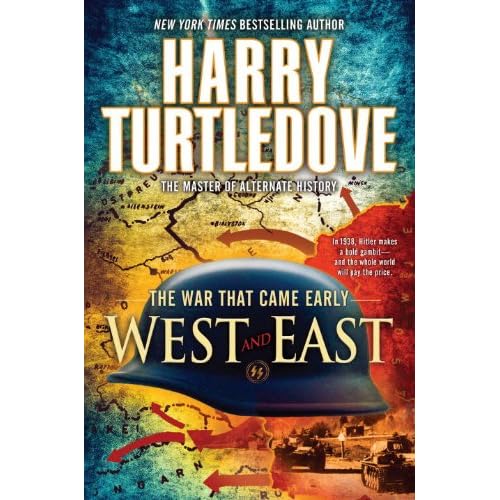
Harry Turtledove - The War That Came Early:West and East: West and East Harry Turtledove - The War That Came Early:West and East


Harry Turtledove has a fascination with World War II. To be sure, the Master of Alternate History as he has often called has wrote plenty of "what if" scenarios about other conflicts, too. But the Second World War seems to be his most popular topic of all. Harry has imagined it from all sorts of angles, including an alien invasion in the middle of the fighting, how it would be different with a German victory, what might have occurred if the Japanese actually invaded Hawaii, and how the sides would have lined up if the South had won the Civil War.

In his latest effort, The War That Came Early: West and East , Turtledove envisions how things might have been different had World War II started about a year earlier than it actually did. The novel is actually a sequel to Hitler's War, the 2009 first installment in what appears to be another Turtledove epic, the author being well known for his penchant for lengthy series.

As The War That Came Early: West and East begins, the war has bogged down in Europe, with the Germans halted just before Paris much the same as they were during the Great War. Neither side can seem to get any momentum going, and the lines of battle remain fairly static. On the Eastern front, the Germans and their Polish allies are making some headway against the Russians, convincing Hitler that more pressure should be applied there.

Of course, the Russians have other worries. The Japanese are advancing on the Manchurian front, managing to capture vast tracts of the Trans-Siberian highway and besieging the port of Vladivostok. Their hope: to cut the behemoth Soviet monster in half and, combined with the German attacks on the European front, bring Mother Russia to her knees.

Meanwhile, the Spanish civil war continues to drag on with no clear victor in sight. And back in Germany, rumblings in the Wehrmacht and among the populace are slowly turning against Hitler's ineffective conduct of the war.....

As per usual, Turtledove tells his tale through the eyes of characters drawn from all sides: Spanish revolutionaries and monarchists; German, Czech, French, English, and Japanese foot soldiers; Russian and German pilots; and a German U-Boat captain. We see the war progress through their eyes, sometimes as they're in the thick of the fighting, other times as they're a mere device listening to radio broadcasts or reading newspapers.

Turtledove's remarkable talent for detail is again readily apparent in The War That Came Early: West and East, and his knowledge of the era, its historical figures, and weaponry is impressive to behold. This helps out a great deal here, especially when the action tends to lag at times. That it does at times, as here the author seems more intent upon character development. Still, there are several gripping moments, most notably an epic sea battle and an aerial attack by the Germans.

The main complaint here is that the plot does not advance notably, and events are not much different here than they were in the first chapter. That's classic Turtledove, however, as we can see the threads of the plot being tied together for some big happenings down the line.

Overall, I enjoyed The War That Came Early: West and East, and tore through its 448 pages (light reading by Turtledove standards) in just a few sittings. While not the best effort from this author, it's recommended to fans of the author, especially those who enjoyed the first book in the series.

Three and a half stars.

Tuesday, October 4, 2011

Didn't Inspire Me to Buy The Next Installment: S.M. Stirling's Dies the Fire


It's amazing how far science and technology have brought the human race. Understanding the basic principles that guide how the universe works, then manipulating those fundamental laws of physics, has allowed us to perform all sorts of amazing feats. Electricity surges through our homes, becoming the life blood that powers a diverse array of mechanical devices that preserve and cook our food, wash our clothes, heat and cool the air, and keep us entertained. Fossil fuels, packed with hydrocarbons, propel aircraft through the skies, automobiles and trucks across an intricate global network of highways, and power farm vehicles that allow us to squeeze enough food out of the land to feed our teeming masses.

But what if, one day, all that was taken away from us? How would the human race survive? Would our social and cultural norms remain intact, or would we revert to the primitive savages we have so painstakingly evolved from over the millennia? Such is the premise of S.M. Sterling's apocalyptic science fiction novel, Dies the Fire.

Somebody up there (or out there) doesn't like us very much. At least, that's how it seems to Iraq war veteran turned bush pilot Mike Havel. In the midst of transporting a wealthy industry magnate and his family to their ranch vacation home in Idaho, a strange story flashes over the news radio. Off the coast of Nantucket, an electromagnetic cloud akin to the aurora borealis is coming in from the sea. Suddenly, the on the scene report abruptly ends. There's no time to wonder at what's going on, however; seconds later, the cloud passes over Mike's plane, and instantaneously all power goes out. Mike manages to make a controlled crash landing on a river, far from help and civilization.

Meanwhile, in rural Oregon, Wicca coven leader Juniper McKenzie is playing at a bar when all the power goes out. Not an unusual occurrence, or so it seems at first, until Juniper and her friends realize that this is far more than a local power outage. Planes are falling out of the skies, electrical watches no longer tick, and even guns no longer work. It isn't long, then, before it becomes apparent that some "change" has been affected upon the entire planet, rendering most of human technology useless.

And so both Mike and Juniper lead intrepid bands of survivors through the isolated regions of the Pacific Northwest. Realizing that they've just been plunged back into the dark ages, both must rely on long-replaced technologies to grow food and make weapons. There are, after all, some who have taken advantage of the Change to set themselves up as warlords who will kill, steal, plunder, and rape to survive. And as the food runs out in the hellish nightmares that the cities have become, they're moving out into the country to find more...

On the surface, Dies the Fire has a rather interesting premise that, if built upon properly, could yield a truly fascinating yarn. And truth be told, this almost 600 page novel does have its moments, and manages to keep the reader's interest almost to the end. The problem, however, is execution, and that becomes something that brings the book down a few pegs.

At first, we're enthralled watching our protagonists fight to survive. Most of civilization has perished around them for simple want of food and medicine. Governments have disintegrated, and civilized society has ceased to exist. Sirling takes great pains going into detail about how those who survive have done so, and that's great-to a point. But there's so much focus on how crops are grown and implements produced that we start to lose interest and hunger for a bit of action.

That comes in spurts, of course, and the author even builds up a warlord in Portland called The Protector to be the foil for our heroes. Problem is, we see The Protector in a whopping two scenes, and he's hardly built up enough to make an interesting villain. That makes the novels' final battle scene extremely anticlimactic, and even a little dull.

Then too, Sirling bases his entire work (and since this is the first installment of a series, future books as well) on a mysterious "Change" that he then quickly discards as a plot device. Who or what was behind the Change? God? Aliens? Some natural phenomenon? We never find out, and the main characters only wonder at it a few times and then in passing. A few obscure references, hints, and clues might have gone a long way to make Dies the Fire a bit more interesting.

Fortunately, there's a saving grace here, and that's the characters. They're well thought out, realistic, and we sympathize with them. The relationships they build with each other are believable, too, and that helps us to identify with them. We ant to know how they're going to survive an attack by cannibals, or whether they'll manage to harvest enough crops to survive the winter.

All in all, I enjoyed Dies the Fire, and will likely get around to picking up the next chapter in the series. But as I read, I couldn't help but dwell upon the squandered opportunities that might have made the story so much better. Three and a half stars overall, I think, and I should add I really wasn't inspired to pick up other installments in this saga.


Wednesday, August 24, 2011

Drew Karpyshyn-Darth Bane, Path of Destruction


“Two there should be; no more, no less. One to embody the power, the other to crave it.”

-Darth Bane.

As we learned in Star Wars: Episode I, The Phantom Menace, there are always two Sith, a master, and an apprentice. Such is the way of the Sith, evil users of the Dark Side of the Force and the perpetual nemesis of the Jedi Knights. But it was not always so. Once, the Sith were as numerous as the Jedi, and swelled their ranks into an evil Brotherhood of Darkness that threatened to march across the galaxy.

And into such times, a millennium before the days of Luke Skywalker, Han Solo, and Princess Leia, was born Dessel, a day laborer trapped mining cortosis on the outer rim, hopelessly in debt to the corporation that sold the extremely strong metal to the republic. Desperately seeking a way off the backwater rock that has become a tomb to so many of his coworkers, Des is constantly getting into trouble. And when things go sour during a card game with Republic troopers, Des makes a fateful decision: to escape his indentured servitude forever and join the armies of the Sith. After all, what has the Republic and it’s Jedi Knights ever done for him?

Des quickly rises through the ranks of the Sith army, with the help of the strange glimpses into the future that he has experienced all his life. In time, he comes to the attention of the Sith Masters, who discover that the Dark Side of the Force rages within him. Sent to Koriban to train in the dark ways of the Sith, Des discards his given name, the last vestige of his old existence, to become Darth Bane. Discovering the ancient Sith holocrons that hold the secrets to the true power of the Dark Side, Bane soon has plans to restore the order to its former glory. And before long, the very Sith Masters who have trained him discover that Bane, whom they had hoped would be a powerful weapon against the Jedi, may turn out to be the instrument of their own destruction instead.

Such is the tale of Star Wars: Darth Bane, Path of Destruction, a very different Star Wars novel set in the days of the Old Republic. With characters and situations far different from those we’ve become accustomed too in any of the Star Wars films, Path of Destruction still has enough familiar to readers to ingrain it into the Star Wars mythos and give it the feel of the saga.

It also makes the book genuinely interesting, delving as it does into a segment of Star Wars lore heretofore previously relegated to the comic book series by Dark Horse. But it does answer questions about why the Sith are always limited to two, questions brought up in the first Star Wars prequel.

Being a tale told mostly from the perspective of the Sith, Path of Destruction, has a decidedly dark tone to it. Then too, character development is relatively minimal, except perhaps for Bane himself, whom we become familiar with but can never really identify with. The plot, too, is a bit predictable, although author Drew Karpyshyn does weave in a few surprises for us along the way.

Most readers will tear through the book’s 389 pages in no time. But most of all, Path of Destruction is great fun, a chance to see a different side of the Star Wars Galaxy and learn more about the evil Sith that we so love to hate. And a way to travel a bit longer ago into that galaxy we love that’s so far, far away.


Wednesday, August 17, 2011

Stephen King-Under the Dome


Hi, I'm John, and I have a confession to make. I've never read a Steven King book before. Oh sure, I've read the occasional King short story (Battleground is simply amazing), and who hasn't seen a movie based upon one of his novels by now? But to sit down and read a full length King novel? No, I've never done that.

I made up for that, though, (and with a vengeance), when I decided to read King's latest epic, Under the Dome. At 1088 pages, this monster seemed to be several books all rolled into one, and would surely either make or break the author for me. The concept looked interesting enough. And although friends would tell me it sounded like something from a Simpson's movie (not true, King envisioned the basic concept decades ago but never got a round to writing the full novel).

On a fine fall day in an undetermined year, drifter Dale Barbara (known as Barbie to his friends) is hiking out of the small western Maine town of Chester's Mill. Barbie is looking for greener pastures after a run-in with the son of the local First Selectman, James "Big Jim" Rennie. Barbie sees the writing on the wall. It is a small town after all, and although well liked at the diner where he works, Barbie is still an outsider.

Problem is, Barbie isn't going to make it out of Chester's Mill. Before he can escape city limits, an impenetrable, invisible dome clamps down over the exact confines of the town's border with the outside world. Nobody knows this, of course, not even Barbie, until planes, cars, and trucks slam into the dome, marking it's borders, or some of them anyway.

Everyone is a loss to explain what's going on. The military quickly cordons off a perimeter around the town, diverting air traffic and keeping folks away from the outside border. Those inside Chester's Mill can't get out, and those outside can't get in, and still, nobody knows why. The dome isn't all that harmful to approach, though it does generate a field effect that causes electronic gadgets to explode if brought too closely. The best scientific minds at the Government's disposal seem to think it's a force field set in place by Extraterrestrials.

With that in mind, Colonel James Cox, an old friend of Dale Barbara's from his military days, assigns him the mission of finding the dome's generator and destroying it. There's just one problem: Big Jim Rennie. Big Jim doesn't like the idea of Barbie having any kind of authority at all, and in fact seems to like the idea of the dome. After all, it allows him to assert control over Chester's Mill in a way he has never been able to before.

But strange things are going on under the dome. People are committing suicide at an unusually high rate just days after the dome clamps down. Children are having seizures and nightmares of falling stars and the world on fire. That means Barbie will have to locate the generator (if it exists) before Rennie does. Because if Big Jim gets to it first, he might just keep it in place. And that would be extremely bad for Chester's Mill in general and Dale Barbara in particular.

Although Under the Dome clocks in at well over 1000 pages, the reader will hardly know it. That's because King keeps us fed with a constant stream of action, intrigue, and suspense. At first, we wonder just what the dome is, where it came from, and why it's there. Is it mystical? Is it alien? King weaves in aspects of both the supernatural and the extraterrestrial to keep us wondering.

After a while, though, we get so caught up in the characters (mostly the machinations of Big Jim Rennie and the exploits of Dale Barbara) that the dome itself starts to fall by the wayside, at least as far as plot is concerned. It's what's going on under the dome that really piques our interest. And how could it not? With serial killings and political power grabs, attempts to break out and to break in, and a number of folks just trying to survive and subdue the fear that grips them all.

King's characters are well fleshed out, and even our protagonists (like Barbie) are not without personality flaws. This, of course, makes them more real. But even the lesser characters are well-detailed and believable, though it's best not to get too attached to them in a Stephen King novel. It's those characters that make the book so enjoyable, however, and the author uses them to craft a case study in human nature and behavior.

Take a small town, already a microcosm in and of itself, and cut it off from the rest of society, and you'll see the best and worst of humanity emerge in short order. That's the essence of Under the Dome, an action packed, well-paced read worth checking out. It's one flaw is the semi-anticlimactic, rather drawn out ending. But once we've gotten that far, the ride has been such fun we hardly even notice.


Monday, August 15, 2011

Mike Stanton-The Prince of Providence: The True Story of Buddy Cianci, America's Most Notorious Mayor, Some Wiseguys, and the Feds


For anybody who has lived in New England anytime during the last twenty-five years, the name Buddy Cianci is likely familiar. For those who spent time in Rhode Island during that period, however, Cianci was more than familiar: he was inescapable. Whether you saw him on the campaign trail, ran into him at a sporting event, heard him hosting a radio talk show, or bought a jar of his marinara sauce at a local supermarket, you just couldn’t live in Rhode Island and not somehow be affected by Vincent A. “Buddy” Cianci, mayor of the state capitol city of Providence.

Living in West Warwick, Rhode Island for many years myself, I can still recall the mayor very clearly. I worked with the brother of one of his police drivers, heard him speak at a dedication in downtown Providence, called into his radio talk show, and saw his sauce being made in a factory in West Warwick. One night during the summer of 2001, after a few beers at Trinity Brewhouse in Providence, I was walking past the Biltmore Hotel, where Cianci lived at the time. I looked through the first-floor window into Davio’s, the Biltmore’s first floor lounge, only to see the mayor himself sitting at the bar, nursing a drink with a sad and melancholy look on his face.

Make no mistake: Buddy Cianci was an extremely complex character. Love him or hate him, the man has led a fascinating career, and his story, told by Pulitzer-Prize winning author Mike Stanton in The Prince of Providence, is proof that the truth really can be stranger than fiction.

In his book, Stanton, a regular reporter for the Providence Journal Bulletin, tells Cianci’s roller-coaster story from his humble beginnings as a prosecutor to his imprisonment for racketeering. Buddy began his career, ironically, trying to prosecute organized crime figures, including famed New England mob boss Raymond Patriarca. But Buddy always wanted more. Since childhood, he had aspirations to public office, telling his friends he would someday be President of the United States.

Realistically, though, Cianci needed to start with something a little less grandiose, and so he ran for and was elected mayor of Providence in 1974. Cianci truly loved the city, and he was a penultimate politician who once cracked that he would attend “the opening of an envelope”. Buddy had a darker side, however, and often used the Police department for his own ends.

That dark side first emerged in the early eighties. After legally separating from his first wife, Cianci became enraged when she had an affair with another man. Luring the offender to his home, Cianci used his city police driver to detain the man. For several hours, the mayor insulted, assaulted, and intimidated the man, brutally punching him and burning him with a cigarette butt. Later, Cianci pleaded guilty to assault charges, ending his term as mayor.

Like the proverbial cat, however, Buddy seemed to have more than a few lives left. He was still immensely popular, and even got his own talk show on a local AM radio station. Eventually he was re-elected as mayor, despite the fact that he was a convicted felon. It seemed, however, that Buddy hadn’t learned the error of his ways, and throughout the nineties Cianci continued to view Providence as his personal fiefdom. Stanton shows the reader an incredibly corrupt administration where public jobs were always for sale and where kickbacks were an accepted part of doing business. As before, the mayor used the police to intimidate political enemies. This time, however, someone was watching: the FBI, and in 2002 Cianci was convicted and sent to prison.

But Stanton also shows another side of Cianci: the mayor who revived a dying city, bringing in new business, overseeing the revitalization of the downtown area, encouraging diversity, overseeing construction of a new Convention Center. Indeed, it is this dichotomy of character that existed in Buddy Cianci that makes his tale so intriguing.

Stanton’s book is brilliant. His research is meticulous, his sources innumerable, his prose entertaining and enlightening. He is extremely thorough in his background examination of pertinent events, whether they are the history of the mob in Rhode Island or a brief biography on an important figure in Cianci’s story.

You don’t have to be a Rhode Islander to enjoy this book. Anyone interested in the behind the scenes machinations of local government will be enthralled by The Prince of Providence. Published in 2003, the book is already rumored to become a motion picture. But don’t wait for the film. Stanton’s book is one of those rare works that plays out so well in the mind’s eye of the reader that it is much better read than seen.


Sunday, August 14, 2011

Michael Holley-Patriot Reign


Anyone who has followed the New England Patriots over the years knows that the past few years have been among the most exciting in the history of the team. The Pats won the Superbowl twice, and became reigning champions for both the 2001 and 2003 seasons. It’s been lots of fun, and those of us like myself who have stuck with the team over the years through thick and thin have finally received our just rewards.

And the fun ain’t over yet. As I type, the Patriots have won their first three games for 2004, as well. Of course, no one can predict the fortunes of football, and there’s no way to predict how New England will come out this year in the playoff scheme of things. But one thing is for certain: Patriots fans will have another rollicking season of great football as their favorite team advances through the close of the year.

That’s pretty much a given, but why, one might ask? The explanation, of course, lies in great degree to the power behind the team on the field: the coaches, owner, and manager who have brought such success to Foxboro. Anyone who doubts this need only read Patriot Reign: Bill Belichick, The Coaches, and The Players Who Built a Champion.

This, the first book by Michael Holley, a former sports columnist for the Boston Globe, is a fascinating behind-the-scenes study of the team some are now referring to as a dynasty. Holley examines the Patriots in just about every way imaginable: from the back office to the fifty yard line, from the training rooms to the practice field.

To a degree, Patriot Reign is a history. And it’s a biography. The book analyzes the reasons the Pats won the Superbowl for 2001 and 2003, and explores why they missed the playoffs for 2002. It explores the pasts of Bob Kraft, the beloved owner of the team; Bill Belichick, the star-crossed coach; and Tom Brady, the young quarterback some are already comparing to Joe Montana.

Football is much more than the physically intensive game you see on the field. It’s a game of strategy, as intense and cerebral as chess. Each and every play in a game must be carefully planned for it to go off just as the coaches want it to. And in Patriot Reign, Holley shows us just why the Patriots plays are pulled off as well as they are. Because of the careful planning and genius of Belichick and his staff.

Then too, Holley provides us with the players’ perspective. How they inter-relate with each other, the coaches, the fans, the opposing teams. Ever wonder just what goes through the mind of a player like Adam Vinatieri, as he walks on the field with seconds left to go in the Superbowl, game hanging on his field goal attempt, not once but twice? Holley gives us an idea.

Certainly, Holley couldn’t pass up throwing a bit of drama into his tale. The rivalry between Belichick and his former mentor Bill Parcells is touched upon briefly, as is the huge debate that raged in New England when Belichick decided to replace popular quarterback Drew Bledsoe with Tom Brady.

At 237 pages, Patriot Reign won’t take up lots of your time to read. You can likely polish it off in the time it takes to watch a couple of games. But it will give you a much better understanding of the game of football.

Do you have to be a New England Patriots fan to enjoy the book? Not at all. Patriot Reign is a brilliant study into the workings of a championship team, one that anyone who enjoys the game of football can appreciate.