Monday, December 26, 2011

I'm On Fire for the Kindle Fire: Review of Amazon's Kindle Fire


Hold on to your hats, folks. I’m about to say something politically incorrect, and then some. But here it goes: Apple is overrated. That’s right, and I’ll say it again in case you didn’t hear me the first time: Apple is overrated. Why would I say this about the folks that brought us the ipod, itunes, and the ipad? Simple: although they’re great innovators, I think they’ve become just a bit too full of themselves. Their products are high quality, but for me not as good as others. Their prices are too high. And they try to keep just a bit too much control on the content you can buy and use on their devices.

Case in Point: my Microsoft Zune HD. I’ve had this MP3 player for a few years now, but I’ve owned Zunes for many years before. To me, it totally outperforms the ipod, simply because it doesn’t try to do too many things. It’s basically a music player with a few extra bells and whistles. It was cheaper by about $75 than an ipod touch. It’s more durable (I’ve dropped it more than a few times; my son dropped his ipod touch once and the wimpy screen broke. Apple wants $150 to fix it). And I get all the music I can listen to for three Zunes devices for $15 a month, with the added bonus of ten songs a month to keep forever. Not gonna get that from itunes, my friends.

That said, when I was in search of a tablet, I still considered the ipad. The first thing that held me back was the price. Averaging $600, it seemed a bit steep. When I heard that Apple was restricting users ability to buy content through other vendors (like books through Amazon’s kindle app, for instance), I was completely turned off. There would be no ipad in my future, and I was ashamed of myself for even considering allowing myself to be assimilated by the iborg.

I went without a tablet for some time, until the HP Touchpad dropped to $99 (I was lucky enough to snag one the day after the price dropped). That little number was a great deal for the price, but lacked the apps that other platforms offered, and for obvious reasons. So, I continued to follow the runors about an upcoming Kindle Tablet, and when Amazon finally announced that the Kindle Fire would be released in November, I was all about it. Here’s why.

Price

At just $199, it’s hard to pass up on the Kindle Fire. That’s a full $300 less than the cheapest ipad, and the deal can get even better. If you’re a fan of Audio books as I am, you can sign up for an Audible.com Gold level membership and get a code for $100 off your Kindle Fire. You can look at that as paying $99 for the Fire if you like, although you do commit to a year of gold membership at $14.95 a month. Even if you look at the entire package as $280 it’s still a great deal, as you’ll get the Kindle Fire and a free Audio book a month for the duration of your membership. Titles are great, too, my initial selection being Steven King’s 11-22-63, only a month off the presses.

To be sure, the price means you’ll sacrifice a few things. There is no camera or microphone here. You can’t buy a data plan with any of the major carriers, if that’s your thing. And some of the features that were so beloved on the original Kindle (like e-ink, free downloads over the Amazon cellular “Whispernet”, and text-to-speech are sadly gone).

Initial Impressions

Right out of the box my Kindle Fire was fully charged and set up with my account. With its 7-inch display, the Fire was noticeably smaller than the ipad and many other tablets. Indeed, I suppose I had been spoiled for the few months that I had used my HP Touchpad with its larger, rectangular display that is almost 10 inches in size. Still, the Kindle’s compact frame is not without its benefits. It is noticeably lighter and far less bulky than my HP was, and sports a widescreen format that is perfect for watching films and to simulate a book reading experience.

Construction seems tough, too, and I imagine that this sturdy little workhorse could take years worth of everyday use, and maybe even a little bit of abuse. The hard plastic case surrounds the back of the Fire and protects it like a glove of chain mail. The front display is likewise encased in sturdy seeming glass.

Back to the aforementioned size of the Fire. Once I had used it a few times, it started to grow on me. My Touchpad was a bit bulky and unwieldy (for example, when using it at the bar taking tasting notes it was a bit too big). The Kindle is much easier to maneuver in such circumstances. When reading or watching a video, I can hold it with one hand just like a paperback. It’s much lighter and more portable, and I can even fit it in my pocket when I am out and about.

A few observations of minor annoyance. There is no external volume control, and the speakers and on/off button are poorly placed at the top and bottom of the device. Holding the device like a book, I am constantly hitting the power button, prompting the device to ask me if I want to turn it off. Frustrating. The power cord is dedicated, unlike with my classic Kindle. On that device, a wall outlet plug easily decoupled from the cable, allowing use of the cable for USB access of the device. The Fire does not come with a USB cable. Then too, it has the annoying habit or requiring a restart sometimes after I’ve charged it.

Navigation

Once you begin to use your Fire, you will find it fairly intuitive. The home screen is where the action is at, and you can always navigate to it from any book, video, or app by tapping the screen at the bottom to retrieve the menu; then hit the home icon. It’s that easy. Once there, you will notice key information displayed at the top of the screen: “alerts” about software updates, new e-mail, and even a friend’s latest move in “Words With friends”; the time; Wi Fi status; and battery strength.
Clicking on the “Gear” icon brings you to your settings menu. Here you can lock and unlock your device, adjust volume, screen brightness, see and choose wireless networks, sync with Amazon, see device information, and much more.

You have several ways to access your content. The home screen is presented as a sort of bookshelf, with a row of your most recently used books, apps, videos, and websites. This is called the “carousel”, and you can scroll through it with the touch of a finger. Any time you access anything in the carousel, it gets bumped to the front of the line.

Holding your finger on a content pane in the carousel allows you to delete it from rotation, delete it from the device, or add it to your favorites. Favorites are displayed on a lower “shelf” on the home screen, right below the carousel.
You can also access content directly by category from a menu above the carousel. Options are Newsstand, Books, Music, Video, Docs, Apps, and Web. From each of these categories, you can see content on the device and in the “cloud”, and also access the Amazon store to purchase more.

The Cloud

While the cloud is all the rage these days, it’s really nothing more than remote storage. The Kindle Fire comes complete with 8GB of internal storage. Here’s the problem: with all of the content available for the Fire, you’ll blow through that 8GB in no time if you’re not careful. And as usually is the case, you won’t even get the whole 8 GB. Hence, the Cloud. The Cloud allows you to store content on Amazon’s servers for access through a Wi-Fi connection. The Fire has excellent Wi Fi detection and transfer speed capabilities, allowing you to transfer files in no time. Unlike the classic kindle, the Fire does not have cellular data access.

Amazon gives anyone with an Amazon account 5 GB of storage space for free. You can use it to store documents, videos, and music for your Fire. Any music, magazines, books, and videos you purchase through Amazon do not count towards your limit. Need more space for your stuff? Amazon offers the option to buy more, the cheapest plan being $20 for an upgrade to 20 GB. Best of all, this option includes unlimited music storage.

Categories

Let’s take a look at each category of content.

Newsstand

Amazon offers a number of magazines and newspapers by single issue or by subscription. You can find such favorites as Time, The Economist, Forbes, Us, Popular Science, and much more. This is one area where the Fire clearly outshines the classic Kindle, as brilliant full color photos, so important to a total magazine experience, never looked good in black and white. Here, they come to life vividly.

Books

When I bought my first kindle years ago, it was as an e-reader, pure and simple. Sadly, the Kindle Fire is not quite as efficient an e-reader as the classic Kindle. This is because the e-ink display is gone if favor of full color LCD. I can read this display comfortably for a few hours, but not so long as I can e-ink. On the plus side, the Fire is much better for night reading, and I can read in bed without disturbing my Beloved Barbara.

Amazon has a massive library of books to choose from, most of the latest titles and lots of classics, too. Many books are free. With my Amazon Prime membership, I can also check out more recent books one at a time, at no charge. I had a large library already from Amazon, so I was good to go with my new Fire. I generally keep a few on my device and store the rest in the cloud for later retrieval. As with all e-readers, I love the convenience of being able to download a book the day it is released. No trip to the store required.

Also par for the course is the ability to adjust display (meaning font and print size) to your liking, though sadly gone is the text-to-speech option. Here’s hoping Amazon brings it back through a software update.

Music

The Fire is a surprisingly good music player. Although it will never replace my Zune as my preferred music device, I do enjoy streaming music from the cloud while web surfing or playing games. The Fire’s speakers are not going to give you a memorable audio experience by any means, but with a set of headphones my music content sounds very good, indeed.

Video

Right off the bat, I have a beef: Microsoft Windows Media Player is not supported. Nor is itunes, though as Apple is competing with ipad I can understand that. Here’s the problem that poses, though. None of the Digital Copy included with Blu Ray movies I have purchased works with the Fire. Very annoying, that.

That said, there are plenty of options for video with the Fire. The Amazon video store offers a large library to select from, and with my Prime membership I can stream thousands of titles for free. Much more content is available for rental or purchase. Any purchased content can be accessed from the cloud or the device.
When renting a title, Amazon offers the convenient option of downloading to the device so that it can be accessed when Wi Fi is not available. You have 30 days to start watching, once you do the content will be deleted after a 48-hour window.

Documents

Documents can be accessed from the cloud or the device for access as well. Quickoffice is included at no charge with your Fire. This comes in handy, though the files are locked for read access (though different apps allow you to alter them). Right off the bat, the Fire impressed me with its ability to handle very large spreadsheets with ease; on my Touchpad the same files were clunky and almost impossible to navigate through.

Apps

In a nutshell, this is why I replaced my HP Touchpad with a fire. WebOS just did not offer the apps that are available in the Android Market Place. To be sure, Amazon does not offer all the Android apps through the Fire; even if they did, Apple surely offers more. If there’s one thing I’ve noticed about Apps, though, it is that 95% of them are a waste of time, and I can get just about everything I need from Android.

From the Ubiquitous Angry Birds to Words With Friends, Amazon had me covered. There are many free useful apps like scientific calculators, notepads, weather forecasts, and more. Movies and TV can be streamed through the Netflix app, while Pandora and iheartradio offer music broadcasts. I was even able to purchase an add on app for my Collectorz.com Desktop PC software that allows me to update my comic book collection on my Fire, so I can easily tell what issues I am missing. The Audible.com app allows me to play, bookmark, and navigate through audio books with ease.

Bottom line for me is that the apps catalog on Amazon suits my needs, and while I may not always be able to get an app I want, I can always find the app I need.

Web

Amazon uses its own web browser for the Fire. It’s intuitive, learns from the sites you visit most frequently, and starts loading them in advance on its servers when you start surfing. You can bookmark favorites, and websites look good when displayed in either mobile or normal formats.

Performance

Performance of the Kindle Fire has pleased me overall. Web pages load quickly and neatly in the custom browser, and it seems to handle some nicely even when they only support limited formats. Wi Fi reception is excellent, and the Fire detects and picks up networks better than my Touchpad did. Videos play on streaming flawlessly, and without buffering after the initial load.

I won’t go all techy on the processor specs, but I will say that my apps work as smooth as glass. I have had the occasional crash, but it’s rare and has only happened while launching an app, not while I was running one. Multitasking of apps doesn’t slow them down, or at least has not yet in my experience.

The display is crisp and clear, and HD movies look very good indeed. The letterbox screen is well suited for displaying them. For reading, the e-ink is sorely missed, but let’s be fair: this is a multi-use device at a bargain price. I can’t read on the Fire as long as I can on my classic Kindle, but I can still go a few hours without too much eye strain. Then too, the Fire is not well suited for reading in bright sunlight, say on the beach.

Battery life is good, I can usually get about 8 hours of combined use out of a charge, though this will vary with the type of use and screen brightness settings.

Overall

Bottom line, the Kindle Fire tries to do lots of things well, and while it does not do all of them as well as dedicated devices do, it does do them all well enough to make me happy. I’m OK with losing the e-ink display, for example, because I can display web pages and read magazines in full color, all while listening to a song should I so desire. For the price, it can’t be beat, and hey, the $400 I saved over the ipad will buy a lot of books, videos, and music for my Fire.

Sunday, November 6, 2011

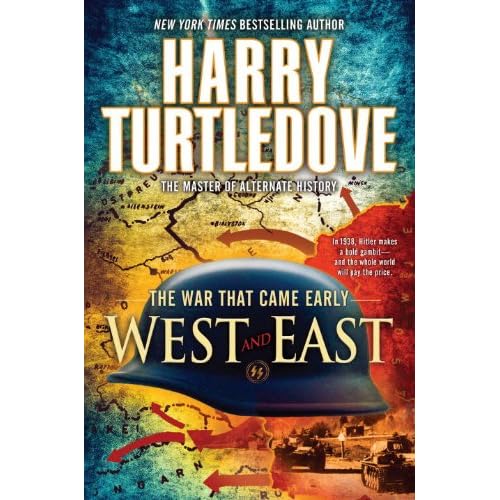
Harry Turtledove - The War That Came Early:West and East: West and East Harry Turtledove - The War That Came Early:West and East


Harry Turtledove has a fascination with World War II. To be sure, the Master of Alternate History as he has often called has wrote plenty of "what if" scenarios about other conflicts, too. But the Second World War seems to be his most popular topic of all. Harry has imagined it from all sorts of angles, including an alien invasion in the middle of the fighting, how it would be different with a German victory, what might have occurred if the Japanese actually invaded Hawaii, and how the sides would have lined up if the South had won the Civil War.

In his latest effort, The War That Came Early: West and East , Turtledove envisions how things might have been different had World War II started about a year earlier than it actually did. The novel is actually a sequel to Hitler's War, the 2009 first installment in what appears to be another Turtledove epic, the author being well known for his penchant for lengthy series.

As The War That Came Early: West and East begins, the war has bogged down in Europe, with the Germans halted just before Paris much the same as they were during the Great War. Neither side can seem to get any momentum going, and the lines of battle remain fairly static. On the Eastern front, the Germans and their Polish allies are making some headway against the Russians, convincing Hitler that more pressure should be applied there.

Of course, the Russians have other worries. The Japanese are advancing on the Manchurian front, managing to capture vast tracts of the Trans-Siberian highway and besieging the port of Vladivostok. Their hope: to cut the behemoth Soviet monster in half and, combined with the German attacks on the European front, bring Mother Russia to her knees.

Meanwhile, the Spanish civil war continues to drag on with no clear victor in sight. And back in Germany, rumblings in the Wehrmacht and among the populace are slowly turning against Hitler's ineffective conduct of the war.....

As per usual, Turtledove tells his tale through the eyes of characters drawn from all sides: Spanish revolutionaries and monarchists; German, Czech, French, English, and Japanese foot soldiers; Russian and German pilots; and a German U-Boat captain. We see the war progress through their eyes, sometimes as they're in the thick of the fighting, other times as they're a mere device listening to radio broadcasts or reading newspapers.

Turtledove's remarkable talent for detail is again readily apparent in The War That Came Early: West and East, and his knowledge of the era, its historical figures, and weaponry is impressive to behold. This helps out a great deal here, especially when the action tends to lag at times. That it does at times, as here the author seems more intent upon character development. Still, there are several gripping moments, most notably an epic sea battle and an aerial attack by the Germans.

The main complaint here is that the plot does not advance notably, and events are not much different here than they were in the first chapter. That's classic Turtledove, however, as we can see the threads of the plot being tied together for some big happenings down the line.

Overall, I enjoyed The War That Came Early: West and East, and tore through its 448 pages (light reading by Turtledove standards) in just a few sittings. While not the best effort from this author, it's recommended to fans of the author, especially those who enjoyed the first book in the series.

Three and a half stars.

Tuesday, October 4, 2011

Didn't Inspire Me to Buy The Next Installment: S.M. Stirling's Dies the Fire


It's amazing how far science and technology have brought the human race. Understanding the basic principles that guide how the universe works, then manipulating those fundamental laws of physics, has allowed us to perform all sorts of amazing feats. Electricity surges through our homes, becoming the life blood that powers a diverse array of mechanical devices that preserve and cook our food, wash our clothes, heat and cool the air, and keep us entertained. Fossil fuels, packed with hydrocarbons, propel aircraft through the skies, automobiles and trucks across an intricate global network of highways, and power farm vehicles that allow us to squeeze enough food out of the land to feed our teeming masses.

But what if, one day, all that was taken away from us? How would the human race survive? Would our social and cultural norms remain intact, or would we revert to the primitive savages we have so painstakingly evolved from over the millennia? Such is the premise of S.M. Sterling's apocalyptic science fiction novel, Dies the Fire.

Somebody up there (or out there) doesn't like us very much. At least, that's how it seems to Iraq war veteran turned bush pilot Mike Havel. In the midst of transporting a wealthy industry magnate and his family to their ranch vacation home in Idaho, a strange story flashes over the news radio. Off the coast of Nantucket, an electromagnetic cloud akin to the aurora borealis is coming in from the sea. Suddenly, the on the scene report abruptly ends. There's no time to wonder at what's going on, however; seconds later, the cloud passes over Mike's plane, and instantaneously all power goes out. Mike manages to make a controlled crash landing on a river, far from help and civilization.

Meanwhile, in rural Oregon, Wicca coven leader Juniper McKenzie is playing at a bar when all the power goes out. Not an unusual occurrence, or so it seems at first, until Juniper and her friends realize that this is far more than a local power outage. Planes are falling out of the skies, electrical watches no longer tick, and even guns no longer work. It isn't long, then, before it becomes apparent that some "change" has been affected upon the entire planet, rendering most of human technology useless.

And so both Mike and Juniper lead intrepid bands of survivors through the isolated regions of the Pacific Northwest. Realizing that they've just been plunged back into the dark ages, both must rely on long-replaced technologies to grow food and make weapons. There are, after all, some who have taken advantage of the Change to set themselves up as warlords who will kill, steal, plunder, and rape to survive. And as the food runs out in the hellish nightmares that the cities have become, they're moving out into the country to find more...

On the surface, Dies the Fire has a rather interesting premise that, if built upon properly, could yield a truly fascinating yarn. And truth be told, this almost 600 page novel does have its moments, and manages to keep the reader's interest almost to the end. The problem, however, is execution, and that becomes something that brings the book down a few pegs.

At first, we're enthralled watching our protagonists fight to survive. Most of civilization has perished around them for simple want of food and medicine. Governments have disintegrated, and civilized society has ceased to exist. Sirling takes great pains going into detail about how those who survive have done so, and that's great-to a point. But there's so much focus on how crops are grown and implements produced that we start to lose interest and hunger for a bit of action.

That comes in spurts, of course, and the author even builds up a warlord in Portland called The Protector to be the foil for our heroes. Problem is, we see The Protector in a whopping two scenes, and he's hardly built up enough to make an interesting villain. That makes the novels' final battle scene extremely anticlimactic, and even a little dull.

Then too, Sirling bases his entire work (and since this is the first installment of a series, future books as well) on a mysterious "Change" that he then quickly discards as a plot device. Who or what was behind the Change? God? Aliens? Some natural phenomenon? We never find out, and the main characters only wonder at it a few times and then in passing. A few obscure references, hints, and clues might have gone a long way to make Dies the Fire a bit more interesting.

Fortunately, there's a saving grace here, and that's the characters. They're well thought out, realistic, and we sympathize with them. The relationships they build with each other are believable, too, and that helps us to identify with them. We ant to know how they're going to survive an attack by cannibals, or whether they'll manage to harvest enough crops to survive the winter.

All in all, I enjoyed Dies the Fire, and will likely get around to picking up the next chapter in the series. But as I read, I couldn't help but dwell upon the squandered opportunities that might have made the story so much better. Three and a half stars overall, I think, and I should add I really wasn't inspired to pick up other installments in this saga.


Wednesday, August 24, 2011

Drew Karpyshyn-Darth Bane, Path of Destruction


“Two there should be; no more, no less. One to embody the power, the other to crave it.”

-Darth Bane.

As we learned in Star Wars: Episode I, The Phantom Menace, there are always two Sith, a master, and an apprentice. Such is the way of the Sith, evil users of the Dark Side of the Force and the perpetual nemesis of the Jedi Knights. But it was not always so. Once, the Sith were as numerous as the Jedi, and swelled their ranks into an evil Brotherhood of Darkness that threatened to march across the galaxy.

And into such times, a millennium before the days of Luke Skywalker, Han Solo, and Princess Leia, was born Dessel, a day laborer trapped mining cortosis on the outer rim, hopelessly in debt to the corporation that sold the extremely strong metal to the republic. Desperately seeking a way off the backwater rock that has become a tomb to so many of his coworkers, Des is constantly getting into trouble. And when things go sour during a card game with Republic troopers, Des makes a fateful decision: to escape his indentured servitude forever and join the armies of the Sith. After all, what has the Republic and it’s Jedi Knights ever done for him?

Des quickly rises through the ranks of the Sith army, with the help of the strange glimpses into the future that he has experienced all his life. In time, he comes to the attention of the Sith Masters, who discover that the Dark Side of the Force rages within him. Sent to Koriban to train in the dark ways of the Sith, Des discards his given name, the last vestige of his old existence, to become Darth Bane. Discovering the ancient Sith holocrons that hold the secrets to the true power of the Dark Side, Bane soon has plans to restore the order to its former glory. And before long, the very Sith Masters who have trained him discover that Bane, whom they had hoped would be a powerful weapon against the Jedi, may turn out to be the instrument of their own destruction instead.

Such is the tale of Star Wars: Darth Bane, Path of Destruction, a very different Star Wars novel set in the days of the Old Republic. With characters and situations far different from those we’ve become accustomed too in any of the Star Wars films, Path of Destruction still has enough familiar to readers to ingrain it into the Star Wars mythos and give it the feel of the saga.

It also makes the book genuinely interesting, delving as it does into a segment of Star Wars lore heretofore previously relegated to the comic book series by Dark Horse. But it does answer questions about why the Sith are always limited to two, questions brought up in the first Star Wars prequel.

Being a tale told mostly from the perspective of the Sith, Path of Destruction, has a decidedly dark tone to it. Then too, character development is relatively minimal, except perhaps for Bane himself, whom we become familiar with but can never really identify with. The plot, too, is a bit predictable, although author Drew Karpyshyn does weave in a few surprises for us along the way.

Most readers will tear through the book’s 389 pages in no time. But most of all, Path of Destruction is great fun, a chance to see a different side of the Star Wars Galaxy and learn more about the evil Sith that we so love to hate. And a way to travel a bit longer ago into that galaxy we love that’s so far, far away.


Wednesday, August 17, 2011

Stephen King-Under the Dome


Hi, I'm John, and I have a confession to make. I've never read a Steven King book before. Oh sure, I've read the occasional King short story (Battleground is simply amazing), and who hasn't seen a movie based upon one of his novels by now? But to sit down and read a full length King novel? No, I've never done that.

I made up for that, though, (and with a vengeance), when I decided to read King's latest epic, Under the Dome. At 1088 pages, this monster seemed to be several books all rolled into one, and would surely either make or break the author for me. The concept looked interesting enough. And although friends would tell me it sounded like something from a Simpson's movie (not true, King envisioned the basic concept decades ago but never got a round to writing the full novel).

On a fine fall day in an undetermined year, drifter Dale Barbara (known as Barbie to his friends) is hiking out of the small western Maine town of Chester's Mill. Barbie is looking for greener pastures after a run-in with the son of the local First Selectman, James "Big Jim" Rennie. Barbie sees the writing on the wall. It is a small town after all, and although well liked at the diner where he works, Barbie is still an outsider.

Problem is, Barbie isn't going to make it out of Chester's Mill. Before he can escape city limits, an impenetrable, invisible dome clamps down over the exact confines of the town's border with the outside world. Nobody knows this, of course, not even Barbie, until planes, cars, and trucks slam into the dome, marking it's borders, or some of them anyway.

Everyone is a loss to explain what's going on. The military quickly cordons off a perimeter around the town, diverting air traffic and keeping folks away from the outside border. Those inside Chester's Mill can't get out, and those outside can't get in, and still, nobody knows why. The dome isn't all that harmful to approach, though it does generate a field effect that causes electronic gadgets to explode if brought too closely. The best scientific minds at the Government's disposal seem to think it's a force field set in place by Extraterrestrials.

With that in mind, Colonel James Cox, an old friend of Dale Barbara's from his military days, assigns him the mission of finding the dome's generator and destroying it. There's just one problem: Big Jim Rennie. Big Jim doesn't like the idea of Barbie having any kind of authority at all, and in fact seems to like the idea of the dome. After all, it allows him to assert control over Chester's Mill in a way he has never been able to before.

But strange things are going on under the dome. People are committing suicide at an unusually high rate just days after the dome clamps down. Children are having seizures and nightmares of falling stars and the world on fire. That means Barbie will have to locate the generator (if it exists) before Rennie does. Because if Big Jim gets to it first, he might just keep it in place. And that would be extremely bad for Chester's Mill in general and Dale Barbara in particular.

Although Under the Dome clocks in at well over 1000 pages, the reader will hardly know it. That's because King keeps us fed with a constant stream of action, intrigue, and suspense. At first, we wonder just what the dome is, where it came from, and why it's there. Is it mystical? Is it alien? King weaves in aspects of both the supernatural and the extraterrestrial to keep us wondering.

After a while, though, we get so caught up in the characters (mostly the machinations of Big Jim Rennie and the exploits of Dale Barbara) that the dome itself starts to fall by the wayside, at least as far as plot is concerned. It's what's going on under the dome that really piques our interest. And how could it not? With serial killings and political power grabs, attempts to break out and to break in, and a number of folks just trying to survive and subdue the fear that grips them all.

King's characters are well fleshed out, and even our protagonists (like Barbie) are not without personality flaws. This, of course, makes them more real. But even the lesser characters are well-detailed and believable, though it's best not to get too attached to them in a Stephen King novel. It's those characters that make the book so enjoyable, however, and the author uses them to craft a case study in human nature and behavior.

Take a small town, already a microcosm in and of itself, and cut it off from the rest of society, and you'll see the best and worst of humanity emerge in short order. That's the essence of Under the Dome, an action packed, well-paced read worth checking out. It's one flaw is the semi-anticlimactic, rather drawn out ending. But once we've gotten that far, the ride has been such fun we hardly even notice.


Monday, August 15, 2011

Mike Stanton-The Prince of Providence: The True Story of Buddy Cianci, America's Most Notorious Mayor, Some Wiseguys, and the Feds


For anybody who has lived in New England anytime during the last twenty-five years, the name Buddy Cianci is likely familiar. For those who spent time in Rhode Island during that period, however, Cianci was more than familiar: he was inescapable. Whether you saw him on the campaign trail, ran into him at a sporting event, heard him hosting a radio talk show, or bought a jar of his marinara sauce at a local supermarket, you just couldn’t live in Rhode Island and not somehow be affected by Vincent A. “Buddy” Cianci, mayor of the state capitol city of Providence.

Living in West Warwick, Rhode Island for many years myself, I can still recall the mayor very clearly. I worked with the brother of one of his police drivers, heard him speak at a dedication in downtown Providence, called into his radio talk show, and saw his sauce being made in a factory in West Warwick. One night during the summer of 2001, after a few beers at Trinity Brewhouse in Providence, I was walking past the Biltmore Hotel, where Cianci lived at the time. I looked through the first-floor window into Davio’s, the Biltmore’s first floor lounge, only to see the mayor himself sitting at the bar, nursing a drink with a sad and melancholy look on his face.

Make no mistake: Buddy Cianci was an extremely complex character. Love him or hate him, the man has led a fascinating career, and his story, told by Pulitzer-Prize winning author Mike Stanton in The Prince of Providence, is proof that the truth really can be stranger than fiction.

In his book, Stanton, a regular reporter for the Providence Journal Bulletin, tells Cianci’s roller-coaster story from his humble beginnings as a prosecutor to his imprisonment for racketeering. Buddy began his career, ironically, trying to prosecute organized crime figures, including famed New England mob boss Raymond Patriarca. But Buddy always wanted more. Since childhood, he had aspirations to public office, telling his friends he would someday be President of the United States.

Realistically, though, Cianci needed to start with something a little less grandiose, and so he ran for and was elected mayor of Providence in 1974. Cianci truly loved the city, and he was a penultimate politician who once cracked that he would attend “the opening of an envelope”. Buddy had a darker side, however, and often used the Police department for his own ends.

That dark side first emerged in the early eighties. After legally separating from his first wife, Cianci became enraged when she had an affair with another man. Luring the offender to his home, Cianci used his city police driver to detain the man. For several hours, the mayor insulted, assaulted, and intimidated the man, brutally punching him and burning him with a cigarette butt. Later, Cianci pleaded guilty to assault charges, ending his term as mayor.

Like the proverbial cat, however, Buddy seemed to have more than a few lives left. He was still immensely popular, and even got his own talk show on a local AM radio station. Eventually he was re-elected as mayor, despite the fact that he was a convicted felon. It seemed, however, that Buddy hadn’t learned the error of his ways, and throughout the nineties Cianci continued to view Providence as his personal fiefdom. Stanton shows the reader an incredibly corrupt administration where public jobs were always for sale and where kickbacks were an accepted part of doing business. As before, the mayor used the police to intimidate political enemies. This time, however, someone was watching: the FBI, and in 2002 Cianci was convicted and sent to prison.

But Stanton also shows another side of Cianci: the mayor who revived a dying city, bringing in new business, overseeing the revitalization of the downtown area, encouraging diversity, overseeing construction of a new Convention Center. Indeed, it is this dichotomy of character that existed in Buddy Cianci that makes his tale so intriguing.

Stanton’s book is brilliant. His research is meticulous, his sources innumerable, his prose entertaining and enlightening. He is extremely thorough in his background examination of pertinent events, whether they are the history of the mob in Rhode Island or a brief biography on an important figure in Cianci’s story.

You don’t have to be a Rhode Islander to enjoy this book. Anyone interested in the behind the scenes machinations of local government will be enthralled by The Prince of Providence. Published in 2003, the book is already rumored to become a motion picture. But don’t wait for the film. Stanton’s book is one of those rare works that plays out so well in the mind’s eye of the reader that it is much better read than seen.


Sunday, August 14, 2011

Michael Holley-Patriot Reign


Anyone who has followed the New England Patriots over the years knows that the past few years have been among the most exciting in the history of the team. The Pats won the Superbowl twice, and became reigning champions for both the 2001 and 2003 seasons. It’s been lots of fun, and those of us like myself who have stuck with the team over the years through thick and thin have finally received our just rewards.

And the fun ain’t over yet. As I type, the Patriots have won their first three games for 2004, as well. Of course, no one can predict the fortunes of football, and there’s no way to predict how New England will come out this year in the playoff scheme of things. But one thing is for certain: Patriots fans will have another rollicking season of great football as their favorite team advances through the close of the year.

That’s pretty much a given, but why, one might ask? The explanation, of course, lies in great degree to the power behind the team on the field: the coaches, owner, and manager who have brought such success to Foxboro. Anyone who doubts this need only read Patriot Reign: Bill Belichick, The Coaches, and The Players Who Built a Champion.

This, the first book by Michael Holley, a former sports columnist for the Boston Globe, is a fascinating behind-the-scenes study of the team some are now referring to as a dynasty. Holley examines the Patriots in just about every way imaginable: from the back office to the fifty yard line, from the training rooms to the practice field.

To a degree, Patriot Reign is a history. And it’s a biography. The book analyzes the reasons the Pats won the Superbowl for 2001 and 2003, and explores why they missed the playoffs for 2002. It explores the pasts of Bob Kraft, the beloved owner of the team; Bill Belichick, the star-crossed coach; and Tom Brady, the young quarterback some are already comparing to Joe Montana.

Football is much more than the physically intensive game you see on the field. It’s a game of strategy, as intense and cerebral as chess. Each and every play in a game must be carefully planned for it to go off just as the coaches want it to. And in Patriot Reign, Holley shows us just why the Patriots plays are pulled off as well as they are. Because of the careful planning and genius of Belichick and his staff.

Then too, Holley provides us with the players’ perspective. How they inter-relate with each other, the coaches, the fans, the opposing teams. Ever wonder just what goes through the mind of a player like Adam Vinatieri, as he walks on the field with seconds left to go in the Superbowl, game hanging on his field goal attempt, not once but twice? Holley gives us an idea.

Certainly, Holley couldn’t pass up throwing a bit of drama into his tale. The rivalry between Belichick and his former mentor Bill Parcells is touched upon briefly, as is the huge debate that raged in New England when Belichick decided to replace popular quarterback Drew Bledsoe with Tom Brady.

At 237 pages, Patriot Reign won’t take up lots of your time to read. You can likely polish it off in the time it takes to watch a couple of games. But it will give you a much better understanding of the game of football.

Do you have to be a New England Patriots fan to enjoy the book? Not at all. Patriot Reign is a brilliant study into the workings of a championship team, one that anyone who enjoys the game of football can appreciate.


Saturday, August 13, 2011

Harry Turtledove - Hitler's War


In the years before the Nazis invaded Poland on September 1st, 1939, Adolph Hitler was a very lucky man. That's because he mostly got his way without firing a single shot as he made land grabs across Europe. The Allied powers of France and England seemed more than happy to appease him, and Hitler, in turn, was more than happy to oblige with fresh demands once he got what he wanted.

But what if things had gone differently? What if, for example, Hitler had not gotten everything he wanted so quickly, and in fact had to fight for his territorial expansion earlier than history tells us he did? Such is the premise of Hitler's War, the latest work by alternate history master Harry Turtledove. Here, Turtledove posits World War II beginning a year earlier than it in fact did.

It is September, 1938. At a soon to be infamous conference in Munich, Hitler is making demands on England's Chamberlain and France's Daladier. But before German forces can walk into Czechoslovakia unopposed, the Fuhrer receives word that the leader of the Sudeten Germans, Konrad Henlein, has been assassinated by Czech radicals. This is the trigger for war, and Hitler believes that now is the time to strike.

And so, instead of blitzkrieging Poland unopposed in the fall of 1939, the Germans get bogged down fighting the Czechs, France, and England a year earlier. Eventually, the war spills over into the low countries and France proper, but the lightning-fast assaults never materialize. The famous surprise attack through the Ardennes does not work so well as it would in 1940. And so, World War II starts to look more like World War I all over again.

Things are different in other areas, too. In Spain, General Jose Sanjuro does not die in a plane crash, and instead survives to lead the pro-fascist forces there. The Soviets, eager for a land grab of their own, attack Poland, which becomes an ally to the Nazis instead of a victim. And a cabal of Wehrmacht generals tries to take down Hitler, which leads to a purge of the German officer corps by the SS. Hitler's War ends with a the German assault on Paris petering out, and an allied counter-attack just getting under way.

As has become Turtledove's style, Hitler's War is peppered with a polyglot of characters from around the world, some of them real, most of them fictional. Hitler himself has a few appearances, and we also see U-boat commander Julius Lemp, Stuka pilot Hans-Ulrich Rudel, Jose Sanjuro, and Konrad Henlein among the historical characters.

Turtledove's array of fictional characters is robust as well, though most of them seem rather flat and we can't really get much attached to any of them. Perhaps that's because we're still early in an obviously unfolding series, and the author is too busy bouncing around with events to do much character development (though there is just a smidge). Then too, the plot doesn't flow nearly so well as in other Turtledove series (for example, the Timeline 191 epic or the Worldwar series).

Where Turtledove does excel is with his factual data, and we get to know the weapons of war here almost as if they were characters in their own right. Stukas, Hurricanes, Panzer I and II and Matilda tanks all get a detailed treatment, and they're intricately woven into the fabric of the story. And with good reason, too, because they change the very nature of the story. For example, because France is invaded in late 1938 instead of May, 1940, the Germans have only the lightly armed and armored Panzer Is and IIs to go up against the much larger French and English tanks. Missing are the Panzer IIIs with their 50MM cannons that proved to be the difference in real history (and still at times had to be employed in packs to take out the more heavily armored enemy tanks).

Despite several flaws, there are enough interesting events going on here to make this reader hunger for more. That's because the great promise of Hitler's War is as a setup for a broader series, which it almost certainly appears to be. Obviously, this is the first part of a larger work, something Turtledove is famous for. And despite the fact that the Germans are not having such an easy time of it in France, this alternate telling of World War II may not have such a quick ending, since Turtledove has posited a Japanese attack on Russia, perhaps in lieu of the assault on Pearl Harbor. That puts the Soviet Union in the middle of a two front war, and possibly leaves the United States out of the fighting, something that leaves the reader to wonder: What If?


Friday, August 12, 2011

David Fromkin - Europe's Last Summer: Who Started The Great War In 1914?


Just who started World War I? That’s a question that historians have debated since, well, World War I. In fact, if you manage to collect a room full of scholars on that tragic conflict, also known as the Great War, you’re likely to get as many opinions as you have bodies. And you may end up with a ruckus that resembles a third world war to boot.

Generally, however, there is a consensus that the First World War was not really started by any one European power, but grew out of the rivalries, power grabs, and alliance structures that had been a fact of Old World realpolitik for centuries. While it’s true that German troops were the first to march against another major power, they did not do so in the same purely aggressive fashion in which the Nazis did two decades later. Instead, they were reacting to a chain of events that spiraled out of control when the Austrian Archduke Franz Ferdinand and his wife Sophie were assassinated by Gavrilo Princips in Late June of 1914.

Or were they? Historian David Fromkin, author of several tomes on the era including a fascinating account of the formation of the modern Middle East entitled A Peace to End All Peace: The Fall of the Ottoman Empire and the Creation of the Modern Middle East, seems to think otherwise. And in Europe’s Last Summer: Who Started the Great War in 1914?, Fromkin attempts to pin the blame on Germany more so than most historians do. He accuses the Germans of seizing hold of the tragic events in Sarajevo and using them as an opportunity to launch a war against Russia and France.

A country being a rather ambiguous entity, Fromkin nails his accusations down even closer to the mark, laying responsibility on just one man: Helmuth Johann Ludwig von Moltke, aka Von Moltke the Younger. Fromkin claims he used his position as head of the General Staff to force the Austrians into war against Serbia and, by extension, Russia, thereby involving Germany in a European struggle for supremacy that he felt was inevitable and that Germany had a better chance of winning in 1914 than she might in, say, 1920. Interestingly, though most have accused Kaiser Wilhelm II of masterminding the war, Fromkin paints him as a monarch who, up until the final moments just before war broke out, tried to avoid a conflict.

But the evidence for this is not completely convincing, and the author tries to make the book into an almost murder mystery –like suspense thriller, saving his revelation of the guilty party until the very end of the work. Even then, the final bit of evidence he lays out is unconvincing, a statement by Von Moltke after the war had begun (and he was, ironically, relieved of command by the Kaiser): where he refers to This war which I prepared and initiated. Likely here he was referring to the fact he was involved in war plans before and during the initial stages of the war, not some sinister scheme for global conquest.

To be sure, Fromkin’s claims are often ambitious, and his supporting evidence is wide open to interpretation throughout the book. He has a knack for molding it to his purpose, as most historians, inevitably yielding to the influence of their own personal bias, are wont to do. He claims, for example, that Germany was well aware that Russia’s mobilization of her army was not an aggressive move, since the Germans must have been well aware that Czar Nicholas could easily mobilize and at the same time keep his army roaming through his country’s massive expanses. This is a bit disingenuous, since Germany may have known he could do this, yet considering Russia’s alliance with France there was no guarantee she would do this.

The format here was a bit annoying too, and I thought the book could have had more neat to it. Set out in multiple chapters each consisting of short segments, this 320 page hardcover must have had a good 20 to 30 pages of blank space inserted. The author does, however, cram a lot of fascinating information into the space he has, and his chronological progression works very well indeed.

Overall, I found Europe’s Last Summer: Who Started the Great War in 1914? an enjoyable read with food for thought to those interested in this period in history. In the final analysis, the author’s argument did not persuade me, but I learned much through reading and enjoyed the book at the same time.


Thomas Hardy-The Well Beloved


It is human nature that, inevitably, we seem to tire of something once we have obtained it. Longing seems to be preferable to us to having, and once we have finally got what we wanted, we often begin our pursuit of our heart’s next desire. Such is our vacillating nature, such is our curse. But can this fickle tendency apply to the affairs of the heart as well?

For one Jocelyn Pierston, native of an idyllic English seaside village, the search for a soul mate, for his perfect female companion, for the ideal of womanhood and beauty, falls into just such a pattern. That’s because Pierston is as fickle as they come, a man to whom the grass always seems greener on the other side.

And hence his “pursuit of the Well-Beloved”. And just what is the Well-beloved? To Jocelyn, the Well-Beloved is the idealistic embodiment of his much sought-for lover. And since his roaming eye can’t stay in one place for very long, so the “spirit” of the well-beloved moves from body to body, migrating from one female form to the next. And so Jocelyn justifies his indecisive nature.

But when Jocelyn is reunited with his childhood companion Avice, now a woman in her own right, he thinks the Well-Beloved may have finally found a permanent home-until Avice is unable to meet him for a prearranged rendezvous one night, and he runs off with another incarnation of the well-beloved.

When that affair turns sour, however, Jocelyn finds it’s too late to patch things up with Avice-she’s married another, and the one who may just have been the true “Well-Beloved” is out of his reach. And he is forced to live with this for the next twenty years of his life.

That is, until he meets Avice’s Daughter Anne, whom he christens Avice the second. Seeing in her the qualities that so appealed to him in the first Avice, some real, some imagined, Pierston soon pronounces her the Well-Beloved born anew. But Avice the second has other ideas, and although the two become friends, their relation can never be more than platonic.

And so Jocelyn goes into retreat fro another twenty years-just long enough to return home for a go at Avice the Third, perhaps a closer copy of the original Avice than her mother was. And though Avice the second encourages the match-telling her daughter that Jocelyn’s kind nature and, more importantly, vast wealth more than makeup for his advanced age-Avice the Third is more inclined to follow her own heart’s desire.

Thomas Hardy may not be among the best know authors of classic literature, but The Pursuit of the Well-Beloved (aka The Well Beloved) is no less a masterpiece for that. Published serially at first (as were many of Charles Dickens novels), the single edition novel first appeared with some modification in 1897.

And it is a telling commentary on human nature. Pierston’s “Well-Beloved” embodies the fickle nature of the human heart, and our tendency to take for granted what we have in favor of something new and exciting. And so it is with Pierston, who has everything in his grasp with Avice, throws it all away, and spends the rest of his life trying to recapture it.

But this nature is not unique to the male of the species, or so Hardy tries to tell us, as Avice the Second, much to Jocelyn’s astonishment , seems to be in the pursuit of a “Well-Beloved” of her own. Indeed, Hardy seems to find that love itself is a poor foundation for a relationship, and those characters in his book that marry for it end up faring badly (hence Avice the Second, unhappy with the path her relationship took, urges Avice the Third to marry Jocelyn for more materialistic reasons).

Hardy has a distinct talent here for fleshing out his characters and the scenic locales in which they dwell. His extremely elegant prose flows across the pages with all the grace of a Beethoven symphony put to words. And his characters and concepts keep the reader engaged all the way through.

Truly, that’s the icing on the cake. In sum, times may change, but human nature does not. And that makes The Pursuit of the Well-Beloved as entertaining and relevant now as it was over a century ago.


Free with the link below.


The Klingon Gambit


It’s hard to believe that the first time I read Robert E. Vardeman’s The Klingon Gambit was more than twenty years ago. But it’s true. I picked up a copy of this, the second original novel in the immensely successful and still ongoing series of Star Trek books when it was first published in 1981. The other day, whilst thumbing through a pile of paperbacks in search of something to read, I found my old dog-eared copy and decided to give it another spin around the block.

As The Klingon Gambit opens, the crew of the Enterprise are busy mapping a new planet, Delta Canaris IV. Before they can complete their mission, however, they receive orders to investigate a distress call from the Vulcan science vessel T’Pau. Upon arrival in the Alnath system, Captain Kirk and crew discover the ship is intact and in perfect working order. Mysteriously, however, each and every crewmember is dead, lying in their bunks with peaceful expressions and absolutely no sign of what caused their demise.

The mystery deepens when an Andorian archaeological team that the Vulcans had transported to the surface of Alnath II is discovered to be alive and well, and completely oblivious to the fate of the T’Pau. The Andorians, it seems, aren’t the only ones interested in Alnath II, as the Klingon dreadnought cruiser Terror, easily capable of outgunning the Enterprise, is soon found to be orbiting the planet.

Since Alnath II is a world belonging neither to the Federation of Planets or the Klingon Empire the Terror has every right to be in orbit. Her appearance and the deaths of the Vulcans, however, immediately cause Captain Kirk to suspect that it is indeed the Klingons who, perhaps using some knew and unknown super weapon, are to blame for the T’Pau’s fate.

As a result, the crew of the Enterprise must find out exactly what happened, and if necessary engage the Terror in hopes of destroying her mysterious secret weapon, if in fact it exists. But something is wrong. The captain can’t seem to make decisions. Spock has become prone to uncharacteristic emotional outbursts. Dr. McCoy eschews his medical equipment in favor of catgut and needles. And Scotty has begun cannibalizing ship systems in an obsessive quest to improve the performance of his precious engines.

When I read this book so many years ago, I really enjoyed it and I recall thinking what a great job the author had done. Perhaps that was due to the relative dearth of Star Trek novels back then. Today, after reading many of the novels in the line that now boasts more than one hundred books, The Klingon Gambit seems to be only an average effort.

To its credit, the book is short, concise, and to the point. At 158 pages, it’s a quick read and the author doesn’t waste a lot of the reader’s time dwelling unduly on situations that don’t advance the story. There are a few truly fun moments, too, and all in all The Klingon Gambit is a novel that fans of the classic Sci-Fi series will enjoy.

Unfortunately, these do not seem to make up for the book’s many flaws. This is mostly because of the characterizations, which though at times capture the feel of Star Trek seem to miss the mark more often than not. Even the Klingons are all wrong, and they just don’t seem like the fierce and warlike villains we are accustomed too.

Vardeman just doesn’t seem to know that much about Star Trek; the reader is left with the feeling that he spent a Saturday afternoon watching a few re-runs and then decided to write a novel. Add to that the fact that the author’s prose is at times clumsy and confusing, and the result is a less than perfect attempt. Really a 2 ½ star book, I can’t justify rounding it up to 3.

That said, hardcore fans may want to read The Klingon Gambit, if only to complete their collection so to speak. For casual readers and those with a passing interest in Star Trek, it might be best to boldly go on to something else.


Star Wars: Death Star by Michael Reaves and Steve Perry


If you've ever listened to Paul Harvey, then you know he's famous for telling us the rest of the story. Authors Steve Perry and Michael Reaves must have listened to Harvey a lot, because in their new collaborative novel Star Wars: Death Star, that's exactly what they do. Give us the rest of the story of the fearsome Death Star, that is, the Empire's moon-sized ultimate weapon with enough firepower to destroy an entire planet.

Well, most of the rest of the story anyway. As the reader delves in to this latest literary installment in the Star Wars saga, the top-secret Death Star is nearing completion after nearly two decades of labor under the direction of one Wilhuff Tarkin, ruthless servant of the evil Emperor Palpatine himself. The station orbits the forbidding and aptly names prison planet Despayre, source of much of the slave labor required to build it.

And as the station prepares to enter service, we are introduced to a cast of characters whose paths are destined to cross when they board the mighty battle station, willingly or not. And they come from all walks of life: a doctor, an imperial pilot and stormtrooper, a crack gunner destined to pull the trigger that can end a world, a librarian, a barkeep, a bouncer, and even a smuggler. And how they deal with their respective roles in the creation and operation of the Death Star is the fabric that is woven into the pages of Star Wars: Death Star.

Authors Perry and Reaves are, of course, no strangers to the Star Wars universe. Having written Star Wars: Shadows of the Empire
and Star Wars: Darth Maul, Shadow Hunter respectively, they are well acquainted with George Lucas characters, and indeed make good use of them here. Darth Vader, Grand Moff Tarkin, and Admiral Motti all have roles to play as the Death Star takes shape. Even expanded universe character Admiral Daala makes an appearance, if only as Tarkin's sex toy.

Mostly, though, the action surrounds the new characters as we are first introduced to them and fate slowly brings them together. And that is a problem, because while mildly amusing, most of them are not really all that endearing to us, and as I read the first half of the book I found myself wondering where all this was going, and only mildly enjoying the story. Then too, there are plot elements that are entered into and never fully explored.


Part of that, too, is because the authors tend to belabor the construction subplots in the wrong area. A description of the physics behind the mighty superlaser is interesting enough, but we learn more about the construction of the cantinas in the long run. In once scene, a major character takes cover in a dress shop. A dress shop.....on the Death Star? Sorry, that just didn't work for this reader.

An interesting facet of Star Wars: Death Star is the way that the story is eventually interwoven with the events of Star Wars Episode IV: A New Hope. At times this is a very clever device, especially when Perry and Reaves explain events in the context of what we now know from the three prequels. They also give us a little more of those events as seen from both the major and minor players. But even this can be tiresome at times, as the authors quote verbatim lines and scenes from the film, doubtless to stretch the novel out to its 363 pages.

All in all, the second half of Death Star recommends it to serious Star Wars fans.


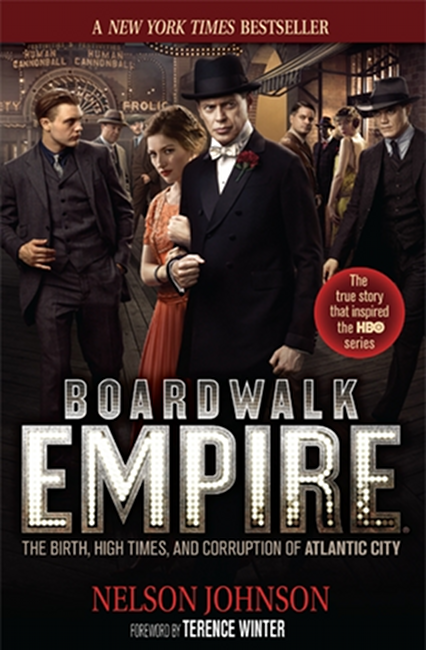
Boardwalk Empire: The Birth, High Times, and Corruption of Atlantic City


In the fall of 2010, HBO released yet another in a long string of acclaimed TV dramas, this one entitled "Boardwalk Empire". The series features Steve Buscemi as corrupt Atlantic City treasurer Enoch "Nucky" Thompson, a prohibition-era boss who controlled his city with an iron grip. What many don't realize, though, is that the series is based on the real-life exploits of Enoch "Nucky" Johnson, as detailed in the book Boardwalk Empire: The Birth, High Times, and Corruption of Atlantic City.

Even if you've never set foot on the Boardwalk or seen an episode of the above mentioned series, Boardwalk Empire: The Birth, High Times, and Corruption of Atlantic City makes for a fascinating read. Part of that is because of the fascinating history behind the emergence of Atlantic City as a modern vacation mecca and gambling emporium. Chock full of fascinating characters, intrigue, and politics, the story of Atlantic City will keep readers glued to its pages from the very first to the very last.

Author Johnson traces the city's origins back to the mid-19th century, when it was little more than a wooded island named Absecon inhabited mostly by swarms of flies and mosquitoes. But for the vision of one Dr. Jonathon Pitney, it might have remained so. Pitney, however, saw the potential of the Island as a health spa and resort for the wealthy. To foster same, he lobbied repeatedly with New Jersey's legislature to have a railroad constructed from Philadelphia to bring guests to the island. Finally, he got what he wanted, and Atlantic City was born.

Atlantic City, however, would not attain fame as a health resort; instead, it rose to infamous glory as a den of iniquity and capitol of vice where gambling, prostitution, and alcohol were always available to those that could pay for them. And pay for those vices they did, swarming in from Philadelphia and later New York for the right to do so.

Through notorious barons the likes of Louis "The Admiral" Kuehnle and Nucky Johnson, Atlantic City became not only a place where vices were readily (and openly) available, it also emerged as one of the most notorious centers of cooperation between organized criminal activities and a seemingly untouchable political machine. As a result, the heart of Boardwalk Empire: The Birth, High Times, and Corruption of Atlantic City is the story of Nucky Johnson.

Johnson controlled his city like few others in American history. His political influence extended well beyond the confines of Atlantic City to the state of New Jersey as a whole, and his control was so complete that for over two decades he was untouchable despite the prevalence of open gambling and, during Prohibition, free flow of alcohol in Atlantic City.

Author Johnson makes Nucky his focus, and rightly so, since he was the driving force in molding Atlantic City into what it was today. He's here to tell us the city's whole story, though, and does so entertainingly and informatively, right on through the eventual legalization of gambling (and the entry of Donald Trump) that saved the city from irrelevance.

The surroundings and landmarks of the city, most notably the famous Boardwalk, are fixtures of the book as well, as we see their evolution through time. Indeed, the latter almost becomes a character in and of itself, as we see how it changes over the years as businesses and hotels are built and demolished along its borders.

Through its pages, Boardwalk Empire: The Birth, High Times, and Corruption of Atlantic City becomes much more than a simple history of Atlantic City. Indeed, it's a fascinating history of America herself as we see this city, vastly different yet in many ways not so different from many other American towns and cities, evolve and grow as the nation emerges on the global stage.

At a mere 312 pages, Boardwalk Empire: The Birth, High Times, and Corruption of Atlantic City won't demand an excess amount of your time. Indeed, perhaps one flaw is that the book is not longer. But the fascinating characters, interesting places, and exotic history recounted here will keep you flying through it so furiously that you'll polish it off in no time anyway. A fascinating read that will have you looking at Atlantic City in a whole new light.


Panzer Operations: The Eastern Front Memoir Of General Raus, 1941-1945


World War II, and you are there. Or, more correctly, Erhard Raus was. Reading his memoirs, however, Panzer Operations: The Eastern Front Memoirs of General Raus, 1941-1945, leaves one with the feel of actually having been in Russia right alongside the author. Translated from the original German Steven H. Newton, Panzer Operations is a fascinating account of fighting on the Russian Front. Indeed, the author's reflections upon his tactics and strategies were considered valuable enough to be quoted and included by the U.S. Army in training and tactical manuals it produced during the nineteen fifties.

Raus was not a native German citizen, having been born in Moravia, part of the Austro-Hungarian Empire. He served with distinction in the Austrian Army during World War I, and was later assimilated into the German Wehrmacht during the Anschluss, or union, of Austria and Germany in 1938. There he served mostly as a staff officer until June of 1941, when he was assigned to command 6th Panzer Division. When Germany invaded Russia on June 22nd, 1941, 6th Panzer-and Raus-were at the forefront of the action.

Raus and his command sliced through the Baltic States of Lithuania, Latvia, and Estonia, eventually crossing into Russia proper and driving on Leningrad. He was an effective commander and was often transferred to the hot spots on the Russian Front, eventually serving in the drive on Moscow, attemot to liberate 6th Army at Stalingrad, the major tank engagements at Kursk and Kharkov, and eventually on the defensive when the Russians invaded Easy Prussia in 1945.

Panzer Operations, at just over 300 pages, is a short and concise read. It is composed entirely of the author's descriptions of his experiences at the front, and the accounts are always extremely interesting. It is his recollection of his unorthodox tactics, however, that will appeal most highly to the military historian. Raus was not averse to "interpreting" orders as suited his purposes, and he had an uncanny knack for guessing the enemy's next move ahead of time.

Then too, the book has historical value, with remarkable insight into some of the major battles of the war on the Russian Front. Raus's remembrance of other events, too, stand out to the reader: the introduction of the heavy Tiger and Panther tanks, small unit actions across the front, meetings with Himmler and Hitler. All of these provide for a fascinating read.

Indeed, this reader found himself a bit skeptical of some of the author's recount about his direct honesty concerning the fate of the war in his meeting with Himmler, but Raus later offers evidence to substantiate his claims. His reputation for honesty and frankness seem to support him as well. That comes through in his writing style, which is mostly functional and informative in nature.

The author caps his work with a critique of where the German campaign in Russia went wrong, and he is critical of overall German strategy and, more directly, Hitler, throughout the book. His recounts of the mistakes the Wehrmacht committed on the Eastern Front are likely a good part of what made Panzer Operations of such interest to the US Army, which was doubtless contemplating a war in Russia of its own during the fifties.

Overall, Panzer Operations is a fascinating read for students of history and military tactics in general, and Word War II especially. Its accounts of actual conflict at the unit and front level will captivate and enthrall. Highly recommended for anyone with an interest in the aforementioned areas.


Red Mars by Kim Stanley Robinson


I have a dream, one that I would like to see fulfilled within my life time. My dream is to see a man (or woman) actually set foot on the planet Mars. Is that too much to hope for? Certainly, by the year 2046 or so (and I hope to be around that long) a manned mission to Mars isn't out of the question. If the Chinese continue on with their aggressive space program, perhaps the US will be spurred into action. Better yet, perhaps a cooperative international effort will be realized.

In the meantime, I’ll have to content myself with movies and books depicting what a Mars mission will be like. And of course, if there is one definitive fictional account of not only the first mission to Mars but also the colonization and terraforming process, it must be Kim Stanley Robinson’s Red Mars.

In reality, Red Mars is only the first book in a series on the human arrival and eventual settlement of Earth’s mysterious red neighbor, with Green Mars and Blue Mars as sequels.

As our story begins, Mars is already colonized, and we see an introduction to a few of the major characters in the book, This serves only as a foreward, however, and the plot shortly jumps back to the actual first colonization itself.

And this is where the book shines. From the outset, we see the “First 100” on their long space journey to Mars, and the author uses this confined setting to give us a bit of character exposition and a little background on the world of 2029.

Once we arrive on Mars, we’re treated to a well-researched, realistic account of how the first human colonies on Mars might be established. The descriptions of the terrain, the atmosphere, the landing, and the construction of the dwellings and farms our protagonists will need to survive are all detailed and accurate.

The science of Red Mars is equally well laid out, and another big reason why the novel works so well. Seemingly outlandish concepts like the space elevator and terraforming seem daunting tasks indeed, but they are firmly grounded in today’s science. Considering that a space elevator for our own planet Earth is seriously being considered and that we are likely in effect already altering our own climate, these concepts should not seem so far-fetched.

Robinson has a talent for making the reader feel as if he or she were right in the midst of the action. Whether he’s talking about plunging an asteroid into Mars atmosphere to add water to it or a simple stroll (in spacesuit) across the Martian landscape, we really get the feel of what it might be like to be on Mars.

Where the book does not work quite so well is with the characters themselves. We never really like them, mostly because Robinson doesn’t focus on any one for long of us to do so. The one who gets the most attention, John, and the one for whom we start to actually identify with, is doomed from the outset. His death is outlined in the very first chapter of the book. As to the rest, we really don't care about them one way or another.

Robinson also brings politics into his story, with the usual strife, greed and warfare on Earth eventually bleeding into Mars. Things become worse, however, when a new DNA treatment is discovered that lengthens the human lifespan. Naturally, the rich get it, the poor don’t, fighting ensues and a population explosion is inevitable.

And that’s when things start to fall apart on Mars, too. It was literally painful to me to watch many of the achievements the author goes to such painstaking detail to create be torn down. And as this happens, Red Mars begins to drag a bit, especially through the last hundred pages or so.

Still, Red Mars is well worth your time, and one of the better Sci-Fi epics out there. It sets the stage for the next two novels nicely, and is entertaining and interesting in its own right.


Jimmy Carter's The Hornet's Nest


You have to admire Jimmy Carter. Former President of the United States, the man did not end his commitment to America when he lost his re-election bid to Ronald Reagan in 1980. Instead, he redoubled his efforts, working to restore America one home at a time, establishing organizations to promote world health and peace, and writing a number of books.

The Hornet’s Nest, Carter’s first and only novel so far, is in fact the first novel ever written by an American President. It is a work of historical fiction, portraying events that mainly occur in Georgia and the Carolinas before and during the Revolutionary War. The characters, both real and fictional, wind their way through the war, and the novel, all the while providing the reader with a genuine feel for what life might have been like at the time.

Ethan Pratt, our main character and protagonist, is a young boy working in his father’s leather shop in Philadelphia as our story opens. We follow Ethan briefly through his youth until he meets his wife to be, Epsey, and eventually moves with her to North Carolina, there to join his brother and make a life for himself and his family.

In time, however, an unfortunate and heartbreaking turn of political events forces Ethan to reconsider his home in North Carolina, and he and Epsey soon decide to relocate to Georgia. There, the two build a farm on the outskirts of a Quaker settlement, and soon befriend a neighboring couple, Mr. and Mrs. Kindred Morris.

As time goes by, Ethan manages to keep himself and his family isolated from the growing conflict of the Revolutionary War. But when Kindred is killed by British troops (despite the fact that he had remained loyal to the crown), Ethan decides to take an active part in the war. His decision becomes a costly one, one that will change his life forever.

Carter has managed to craft a masterful piece of fiction that brings history home and gives the reader a true feel for what the period must have been like. The fictional Ethan Pratt may be the main character here, but Carter is just as likely to throw in real ones, too: Thomas Brown, Lord Cornwallis, Elijah Clarke, and many more.

When the story opens in Philadelphia, we get a vibrant picture of the daily grind of colonial life. Carter’s detail is amazing. He has clearly done his homework, and The Hornet’s Nest in many respects is as educational as many a history text.

Then too, the author is fair in his treatment of both sides. Don’t expect a lopsided read here: Carter is as likely to show the colonials in a bad light as he is the British, and at times shows the better side of each, too. Life is rarely a clear case of black and white, and Carter often manages to portray the differences between Whigs and Tories somewhere in a nebulous grey area in between.

The depictions of conflict are fascinating and accurate, though the author seems to prefer the strategic to the tactical level. Above all, Carter’s detail shines through in every aspect of the work.

The characters are well developed and very believable, and we grieve when some of them meet their fate. In the latter respect, the novel is realistic. There are no superheroes here to win the day, only men and women fighting to survive.

If the book has a flaw, it is the dialogue. There is less of it than one might expect in a novel, with more narration than interaction between characters. When it does exist, it is sometimes awkward, though this seems to be more of a problem at the beginning of the book.

I certainly enjoyed The Hornet’s Nest. Not only because I am a student of history, but also because it was an entertaining story of early Americans in the South. This is great story telling however you slice it, and should appeal to a wide variety of readers.


Thursday, August 11, 2011

Walter Isaacson's Benjamin Franklin, An American Life


Some people truly live life to the fullest. Many such individuals’ lives are not recorded for posterity. But those that are can serve as a shining beacon for the rest of us, an example of not only how to live, but how to live well. One such individual was certainly Benjamin Franklin. Entrepreneur, inventor, social protagonist, statesman, and so much more. The list of Franklin’s accomplishments goes on and on.

Of late, it has become fashionable to examine once again the lives of America’s founding fathers. John Adams, Alexander Hamilton, and Thomas Jefferson have all undergone scrutiny in various works by various authors. Perhaps the most popular figure, however, has been Benjamin Franklin, and I can think of no better work to obtain not only an understanding but indeed a veritable feel for the man than Walter Isaacson’s Benjamin Franklin: An American Life.

It is inevitable that any author will have a bias when approaching an historical topic or figure. Isaacson’s is overwhelmingly positive. That said, his portrait is balanced and accurate overall, and he does not shy away from showing us Franklin’s faults right alongside his strengths.

Franklin may have been most notably associated with Philadelphia, but he was actually born in Boston, moving to Philadelphia as a young boy. There he established his famous printing business, where Poor Richard’s Almanac was born. The Almanac was a wealth of information and wisdom, some of it Franklin’s, some of it not. Many of his quotes remain in common use even today.

Franklin was also a social progressive. To be sure, he believed in the virtues of hard work and the notion that each individual was responsible for his own upkeep. Yet he was also a firm believer in community, and established libraries, insurance companies, fire departments, and helped raise funds for the common good during the revolution. He greatly improved the colonial postal system, too.

Franklin was a famous inventor during his day, and he had a keen mind for science and its practical applications. We’re all familiar with his famous experiment with a key, a kite, and lightning. But did you know it led to his invention of the lightning rod, a boon that has saved many a structure from burning after a lightning strike.

But it may well be in the realm of diplomacy that Franklin should be best remembered by Americans. He was an active participant in the shaping of both the Declaration of Independence and the Constitution. He served as an ambassador to France, and won crucial support there for the fledgling United States in their battle to be free of British rule.

Indeed, those who criticize France for its disagreement with America over the Iraq war lack historical perspective. While it is true that America came to France’s aid against Germany, France had come to America’s long before that during the Revolutionary War. Without French intervention, we likely would have lost the conflict. And without Franklin, who was very highly regarded in Paris, there might not have been French intervention.

Isaacson shows us, however, that despite all that he accomplished in his life, Franklin had flaws. He was not a family man for the most part. He spent much of his life apart from his wife and children in England and in France. He may have been something of a womanizer, though his flirtations were often on a purely intellectual level.

At times, Isaacson waxes comical, not surprising since Franklin’s wit was as prodigious as his intellect. Still, there are times when Franklin is humorous indeed without intending to be so. At one point, he was attempting to simplify the English language through the invention of a phonetic alphabet. Isaacson reports it as follows:

”Kansider Chis alphabet, and giv me instanses af syts Inlis uyrds and saunds az iu mee hink kannat perfektlyi bi eksprest byi it,” went one of his more comprehensible sentences.

Benjamin Franklin: An American Life is a fascinating read, but its also an entertaining one. The author’s prose flows across the page and is a delight to read. He encompasses so many facets of Franklin’s life that he not only enlightens us as to the man, but also the time in which he lived. We learn a lot about what it must have been like to live in the colonial and revolutionary period.

Isaacson also weaves in other important figures of the day, including John Adams, Cotton Mather, Jefferson, Washington, and others. That is, of course, to be expected in a biography where the interaction between historical figures is inevitable. Nonetheless, Isaacson pulls off the feat admirably. There is a section of portraits and images at mid-book as well.

At just under 500 pages, Benjamin Franklin: An American Life is not a book you’ll likely polish off in a day or two. But it is worth the time invested. Benjamin Franklin was an extraordinary man who led an extraordinary life. He has had an impact on most or our lives already. Reading Isaacson’s biography will only make that impact greater.


Harry TurtleDove's The Man With The Iron Heart


Reinhard "Hangman" Heydrich was one of the most ruthless members of the Nazi regime. Head of the dreaded SD (Sicherheitsdienst, or security service), he was a principal behind the bloody Night of the Long Knives when the leaders of the rival paramilitary SA (Sturmabteilung, or stormtroopers) were murdered. Even more ominously, Heydrich was highly influential in coming up with the "Final Solution" that lead to the Holocaust. He reported directly to SS leader Heinrich Himmler until he was assassinated near Prague in 1942.

One can only imagine how the war might have gone differently if Heydrich had survived. Or, one can read The Man with the Iron Heart, where author Harry Turtledove has posited just such a "What If?" scenario. Here, a slight change in events-Heydrich commanding his driver to leave the scene upon being attacked rather than sticking around to fight-is the difference between life and death for the Hangman.

Perhaps it is his brush with death that gives Heydrich second sight, but as the war begins to appear lost in the ensuing years, he prevails upon Himmler to do prepare for the inevitable defeat by stockpiling weapons and specially trained men for a resistance effort against the invading allies. Of course, Hitler must know nothing of the effort, lest he label it defeatism and Himmler and Heydrich traitors.

And so, after the fall of Berlin and the death of the Fuhrer, the "victorious" allies fall under attack by Heydrich's "Werewolves", or resistance fighters. Well ensconced in an underground mountain retreat, Heydrich plans the attacks and gives the orders that make them happen. At first, the allies see them as a nuisance more than a threat. But as the suicide attacks and bombings continue, the allies-especially the United States-must take the threat seriously.

That's because back home, a movement is growing to bring the troops home and end the occupation of Germany. Founded by Diana McGraw, an Indiana housewife whose son was killed by Nazi partisans after the war was "finished", the peace movement grows larger and larger as the casualties continue to mount. And its voice is being heard, as the Republicans in congress challenge President Truman to declare the mission accomplished and bring the boys home. But Truman fears that is playing right into Heydrich's hands-and may mean a return of the Nazis to power in Germany.

It's obvious from early on Turtledove has patterned The Man with the Iron Heart after the current war in Iraq and, to a lesser degree, guerilla warfare in Vietnam-and the author admits as much in an afterward section. But the concept has merit-what would have happened to American resolve after four long years of fighting had the Nazis not simply given up as they did?

As is often the case with Turtledove's novels, the path not taken shares much with actual events in the real world. And in fact, there really was a German "werewolf" resistance effort following the war, though it was poorly organized and never as effective as the author envisions it under Heydrich. And also as his wont, Turtledove sprinkles in a number of real-life characters along with his own to make the action more realistic.

But we never can shake the sense while reading that the book is a bit allegorical and that Turtledove is lecturing us that it would be just as bad an idea for the US to pull out of Iraq as it would be had we left Germany shortly after World War II. Much of that has to do with the Diana McGraw character, who is a dead ringer for Cindy Sheehan, even to the point of becoming a gadfly to Truman just as Sheehan was for George Bush.

Then too, the werewolves themselves are a problem here in the way that Turtledove develops them. While the novel works when Nazi partisans are attacking American and Soviet troops with rockets and bombs, it is much less so when they're committing suicide bombings and hijackings across Europe. After all, such attackers in the Middle East and Asia were usually motivated by the promise of a speedy trip to Paradise in the afterlife-something Nazi ideology could never match.

But in the final analysis, The Man with the Iron Heart is very much an interesting and thought provoking read. The clever ending punctuates the book as a one-off flight of fancy, but also leaves the door open for a sequel (and once Harry churns more than one novel out on a given theme, you know you're in for the long haul).